Best Whop Alternatives for Digital Product Sellers
In this article
Whop is cheap to sell on. That is rarely why people leave.
Its published card fee is 2.7% plus $0.30, lower than most creator platforms. But Whop’s marketplace leans toward communities, software and coaching, and the costs that matter sit in the extras: tax handling, payouts and disputes.
If your product is a printable, an ebook or a course, these Whop alternatives may fit you better. Here is how they compare.
| Platform | Fees | Built-in Traffic | Best For | Payout |
|---|---|---|---|---|
| Whop (baseline) | No monthly fee; 2.7% + $0.30 per domestic card sale plus $0.10 fraud fees, +1.5% international cards, +2% if Whop remits tax; any marketplace commission not published | Yes (Whop marketplace) | Paid communities, software, coaching and info products | Next-day ACH at $2.50 per payout; faster options cost more |
| Stan Store | $29/mo Creator or $99/mo Creator Pro; 0% transaction fee plus card processing | None (link-in-bio) | Social creators who want a bio-link store with courses and bookings | Through your connected processor |
| Gumroad | 10% + $0.50 per direct sale; 30% on Discover marketplace sales; pricing page does not say if card processing is extra | Limited (Discover) | Testing a first product with zero monthly cost and tax handled | Direct deposit or PayPal, by country |
| Payhip | Free plan 5%; Plus $29/mo at 2%; Pro $99/mo at 0%; plus processing | None | Ebooks, printables and templates at low volume | Paid straight to your PayPal or Stripe account |
| Lemon Squeezy | 5% + $0.50 per sale, no monthly fee, tax filing included | None | Software, licenses and global digital sales | Scheduled payouts, check current terms |
| Podia | Mover $42/mo at 5%; Shaker $84/mo at 0% (billed yearly); plus processing | None | Courses, coaching and memberships with email built in | Through Stripe or PayPal |
| Ko-fi | 5% platform fee, or Ko-fi Gold at $12/mo for 0%; plus processing | Small (Ko-fi community) | Tips, memberships and small shops on one page | Through PayPal or Stripe |
| Patreon | 10% of income plus processing, conversion and payout fees | Limited | Ongoing memberships and fan support | Payout fees apply, per Patreon |
Fees per each platform’s own pricing page, read November 2026: Whop fee docs, Stan Store pricing guide, Gumroad, Payhip’s pricing page, Lemon Squeezy, Podia, Ko-fi and Patreon. Payout timing varies by country and processor. Check current terms before you move.
What Are the Best Whop Alternatives?
The best Whop alternatives are Stan Store for a link-in-bio store, Gumroad for zero monthly cost with tax handled, Payhip for the lowest fees on ebooks and printables, Lemon Squeezy for software and global tax, and Podia for courses. Whop’s payment fee docs list 2.7% + $0.30 per domestic card sale, so most alternatives cost more per sale but fit different products.
Whop is a payments platform and marketplace for digital businesses. Whop’s own sell page reports that sellers earned more than $300M on Whop in a single month, and it lists 22M+ monthly active users on its marketplace.
That scale is real. So is the fit problem.
Whop’s own sell page pitches it to communities, software makers, agencies, coaching businesses and clothing brands. A buyer browsing Whop is often looking for an inner circle, not a wedding planner printable or a Notion budget template. If your product sits outside those categories, the marketplace traffic you were promised may never show up for you.
The second reason people look for Whop alternatives is the fee stack. The headline 2.7% + $0.30 is only the card fee. Whop’s fee documentation lists extras you switch on or pay per event:
- +1.5% for international cards and +1% when currency conversion applies
- +2% when Whop collects and remits sales tax for you
- +0.5% for billing automation and +0.8% for payment orchestration, when enabled
- $0.07 per transaction for Radar fraud screening and $0.03 for 3D Secure card checks
- $15 per card dispute
- $2.50 per next-day ACH payout, or 4% + $2.50 for an instant bank deposit
With everything switched on and tax collected, Whop’s own docs put a domestic card sale at 6% + $0.30. That is still competitive. It is just no longer the cheapest option on this list.
One gap: Whop’s fee docs cover its payments product. Neither they nor Whop’s sell page, read in November 2026, say whether a marketplace sale carries an extra commission. We treat that as unknown, so the Whop figures below are payment fees only. Ask Whop support before you compare.
How Much Do You Keep From a $50 Sale on Each Platform?
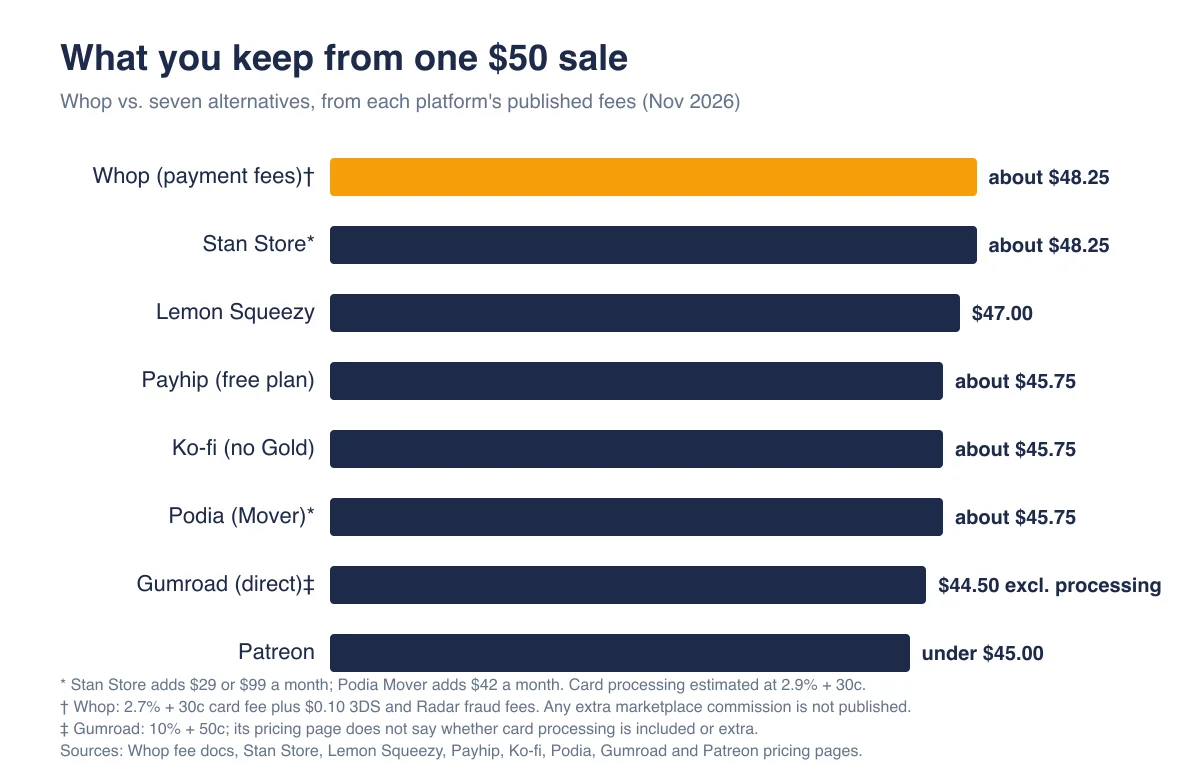
On a $50 domestic card sale, Whop’s published payment fees come to about $1.75: 2.7% + $0.30 plus $0.10 in fraud fees. Lemon Squeezy takes $3.00 with tax handled, Payhip’s free plan about $4.25 after card processing, and Gumroad $5.50 before any card processing. Stan Store and Podia add $29 to $84 in monthly fees.
Percentages are hard to compare in your head. So here is one $50 sale, run through each platform’s published rates. This is our own arithmetic from the pricing pages linked above, not data from a live account.
| Platform | Platform fee on $50 | Card processing | Monthly cost | You keep (before monthly cost) |
|---|---|---|---|---|
| Whop (payment fees) | About $1.75 | Included | $0 | About $48.25 |
| Whop (with tax remitted) | About $2.75 | Included | $0 | About $47.25 |
| Stan Store | $0 | About $1.75 | $29 or $99 | About $48.25 |
| Lemon Squeezy | $3.00 | Included | $0 | $47.00 |
| Payhip (free plan) | $2.50 | About $1.75 | $0 | About $45.75 |
| Ko-fi (no Gold) | $2.50 | About $1.75 | $0 | About $45.75 |
| Podia (Mover) | $2.50 | About $1.75 | $42 | About $45.75 |
| Gumroad (direct sale) | $5.50 | Not stated (excluded here) | $0 | $44.50 excluding processing |
| Patreon | $5.00 | Extra | $0 | Under $45.00 |
“About $1.75” uses the standard Stripe rate of 2.9% + 30 cents that Podia’s pricing page quotes for Stripe and PayPal. Your processor rate may differ by country. Whop’s figure includes its Radar and 3D Secure fees and excludes any marketplace commission, which Whop does not publish. Gumroad’s pricing page does not say whether card processing is extra, so Gumroad is shown without it. If processing is extra at the Stripe rate, you would keep about $42.75.
Two things stand out.
First, on its published payment fees, Whop is cheap per sale. If your product sells well on Whop, leaving to save fees makes little sense.
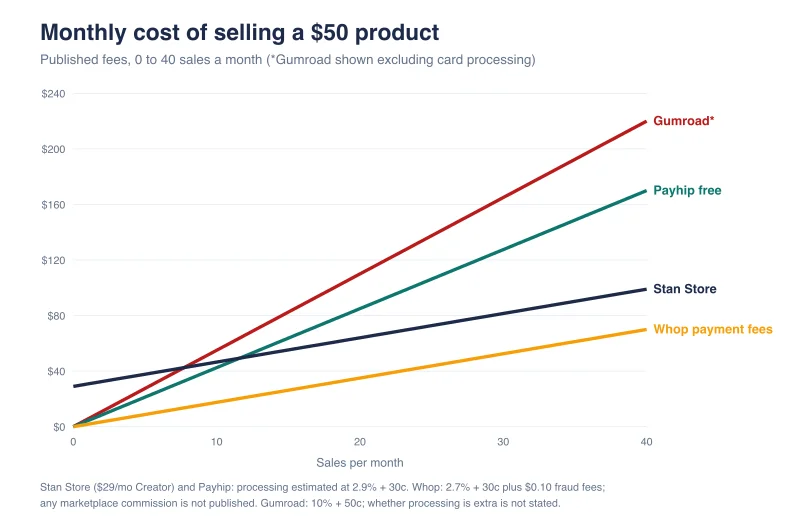
Second, the monthly plans change the picture at low volume. Stan Store’s $29 a month is $29 whether you sell one product or fifty. At five $50 sales a month, that subscription adds about $5.80 per sale. At fifty sales, it adds about $0.58.
Tax is the hidden line. Gumroad has acted as merchant of record since January 1, 2025, per its pricing page, so it collects and remits sales tax worldwide. Lemon Squeezy’s pricing page says the same for VAT and sales tax. On Whop, that service is an extra 2% when enabled. Compare like with like before you decide.
Not sure which platform fits your product? Take the free What digital product should you sell? quiz. Ten questions give you a product type, a platform and three niches to test. About three minutes. Free. No pitch.
Which Whop Alternative Has the Lowest Fees for Ebooks and Printables?
Payhip has the lowest fees for most ebook and printable sellers outside Whop: 5% on the free plan, 2% on Plus at $29 a month and 0% on Pro at $99 a month, per Payhip’s pricing page. Lemon Squeezy charges 5% + $0.50 with tax filing included, which suits sellers with many international buyers.
Payhip is the closest swap for a creator selling files. It handles digital downloads, courses, coaching and memberships, and its free plan has no monthly cost. Payments go to your own PayPal or Stripe account, so card processing is charged by your processor on top of Payhip’s 5%.
That makes Payhip a little more expensive than Whop’s payment fees on a single sale. What you get in return is a storefront built for files: a store builder, themes, marketing tools and email marketing, per Payhip’s site. You will need your own traffic, since Payhip has no marketplace that sends buyers to you. Our Payhip alternatives guide covers when people outgrow it.
Lemon Squeezy charges 5% + $0.50 per sale with no monthly fee. It acts as merchant of record, so it registers for, collects and files VAT and sales tax for you. Its pricing page says some payments outside the US may carry small extra fees.
For a $50 product, Lemon Squeezy’s $3.00 fee sits between Whop and Payhip. For a $5 printable, the fixed $0.50 hurts: it becomes $0.75 total, or 15% of the price. Low-priced files do better on a pure-percentage plan like Payhip’s.
Gumroad is the third choice here. Its 10% + $0.50 on direct sales is the highest headline fee on this list, but you pay nothing until you sell and tax is handled. Sales through Gumroad’s Discover marketplace cost 30%, per Gumroad’s pricing page. We compare it in detail in our Gumroad alternatives guide.
Is Stan Store or Podia Better Than Whop for Courses and Coaching?
Stan Store and Podia both suit course and coaching sellers better than Whop if your audience comes from social media. Stan Store costs $29 or $99 a month with 0% transaction fees, per Stan’s pricing guide. Podia’s Shaker plan costs $84 a month billed yearly with no Podia fee, per Podia’s pricing page.
Whop can host courses. But its tools are built around access: you sell a membership, and buyers get into a Discord, an app or a content feed. If you teach a step-by-step course, a course-first platform gives you more structure.
Stan Store is a link-in-bio store. Courses, digital downloads, coaching bookings and lead magnets all live on one page you put in your Instagram or TikTok bio. Stan’s pricing guide lists the Creator plan at $29 a month ($300 billed yearly) and Creator Pro at $99 a month ($948 billed yearly), with zero transaction fees. Card processing is still charged by your processor.
Stan has no marketplace. Every buyer comes from your own content. If you are posting daily and already have followers asking what you sell, that is fine. If you have no audience yet, Stan’s flat fee is a cost with no sales behind it. Our Stan Store alternatives guide runs that math.
Podia goes deeper on teaching. Its plans include online courses with drip lessons and quizzes, coaching, communities, events and email marketing. Per Podia’s pricing page:
- Mover: $42 a month billed yearly, 5% transaction fee, up to 100 email subscribers
- Shaker: $84 a month billed yearly, no Podia fee, up to 500 email subscribers
- Earthquaker: $150 a month billed yearly, no Podia fee, up to 1,000 email subscribers
Stripe or PayPal processing applies on every plan. Podia makes sense once courses are your main product and you want email in the same place. For a single $20 download, it is more tool than you need. See our Podia alternatives guide for lighter options.
Are Ko-fi or Patreon Good Whop Alternatives for Paid Communities?
Ko-fi and Patreon are the closest Whop alternatives for paid memberships and fan communities. Ko-fi charges a 5% platform fee, or 0% on Ko-fi Gold at $12 a month, per its Gold page. Patreon takes 10% of income plus processing and payout fees, per Patreon’s pricing page. Neither matches Whop’s Discord-first tools.
Paid communities are Whop’s home ground. Whop is built around selling access to a community or app, and its marketplace is where community buyers browse. If you run a paid Discord that already sells there, think hard before you leave.
If your community is looser, such as fans who support your work and get bonus files, two platforms fit well.
Ko-fi started as a tip jar and now covers memberships, a shop and commissions on one page. Ko-fi’s Gold page says the standard plan costs nothing monthly with a 5% platform fee, and Ko-fi Gold costs $12 a month for a 0% platform fee. Processing through PayPal or Stripe applies either way. Our Ko-fi alternatives guide covers its limits.
Patreon is built for recurring membership. Its pricing page says starting is free and Patreon takes 10% of what you earn, plus payment processing, currency conversion, payout fees and taxes. That makes it the most expensive option here per dollar. What you get is a membership home many fans already have an account with.
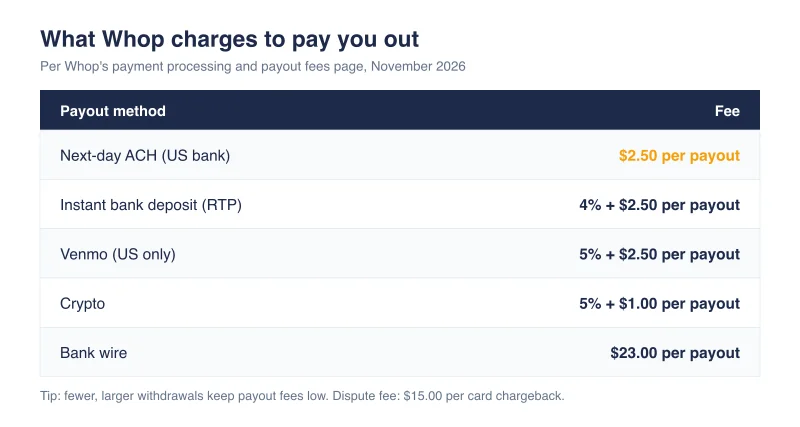
One Whop detail worth checking before you compare: payouts. Per Whop’s fee docs, next-day ACH costs $2.50 per payout, an instant bank deposit costs 4% + $2.50, Venmo costs 5% + $2.50, crypto costs 5% + $1.00 and a bank wire costs $23. If you withdraw small amounts often, those fees add up fast. Withdraw weekly or monthly to keep them low.
Which Whop Alternative Should You Choose?
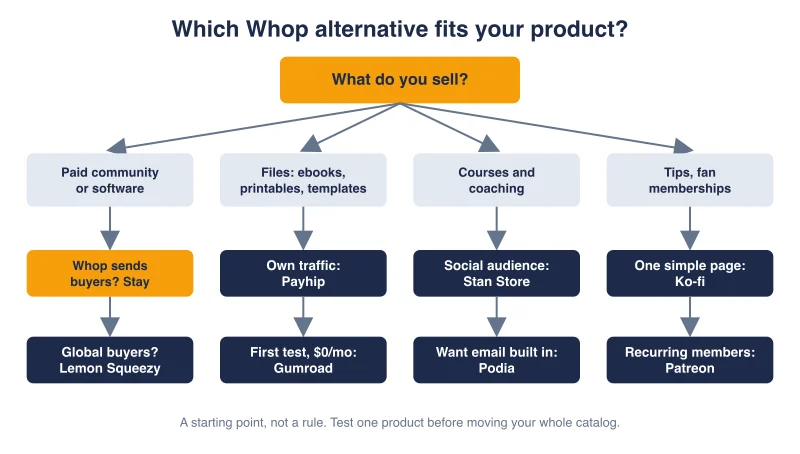
Stay on Whop if you sell a paid community, software or coaching and its marketplace sends you buyers. Choose Payhip for ebooks and printables, Lemon Squeezy for software and global tax, Stan Store for a social bio-link store, Podia for courses and Gumroad to test a first product at zero monthly cost.
Here is the short version.
| Your situation | Best choice |
|---|---|
| You sell a paid Discord, coaching or software and Whop sends buyers | Stay on Whop |
| You sell ebooks, printables or templates and bring your own traffic | Payhip |
| You sell software, licenses or files to buyers in many countries | Lemon Squeezy |
| Your audience is on Instagram or TikTok and you want one bio link | Stan Store |
| Courses and coaching are your main product and you want email built in | Podia |
| You want fans to tip, join or buy from one simple page | Ko-fi |
| You are testing your first product and want zero monthly cost | Gumroad |
Notice what decides it. Fees matter less than fit. The gap between Whop’s published payment fees of about $1.75 and Payhip’s $4.25 on a $50 sale is about $2.50. One extra sale a month from a platform that suits your product covers that many times over.
And one thing none of these platforms does: find your buyers for you. Whop’s marketplace helps if your product matches what its buyers browse for. For everyone else, traffic comes from your own content, search or email list. Our guide to the best platforms to sell digital products covers which ones bring traffic and which only take payments.
The lowest-risk move is not a full migration. List one product on the alternative you are considering, keep your Whop store live, and let a month of real sales show you which one earns more.
Frequently Asked Questions
What is the best alternative to Whop?
It depends on what you sell. Payhip suits ebooks and printables, with a free plan at 5% per sale per its pricing page. Stan Store suits social creators at $29 a month with 0% transaction fees. Lemon Squeezy suits software at 5% + $0.50 with tax filing included. For paid Discord communities, Whop itself is usually still the best fit.
Is Whop cheaper than Gumroad?
On published fees, yes. Whop’s fee docs list 2.7% + $0.30 per domestic card sale plus $0.10 in fraud fees, about $1.75 on a $50 sale. Gumroad lists 10% + $0.50 on direct sales, or $5.50, and its pricing page does not say whether card processing is extra. Two caveats: Whop does not publish whether marketplace sales carry an extra commission, and Gumroad includes tax collection as merchant of record, while Whop charges 2% more for that.
Does Whop take a cut of marketplace sales?
Whop does not say on the pages we read. Its sell page says listing on its marketplace is free, and its fee docs list payment fees of 2.7% + $0.30 per domestic card sale, plus extras for fraud checks, international cards, tax remittance, $15 disputes and payouts from $2.50. Neither page says whether a marketplace-sourced sale carries a further commission, so ask Whop support before you list.
Can I move my products from Whop to another platform?
Yes. Digital files, course videos and product copy can be uploaded again on Payhip, Gumroad, Stan Store, Podia or Lemon Squeezy. The harder part is moving recurring members, since each subscription must restart on the new platform. A low-risk approach is to keep Whop live for current members for one or two billing cycles while new buyers use the new checkout.
Keep Reading
What to Do Next
Choose the path that fits where you are right now.
Score Your Ideas
Answer a few questions about your skills, audience, and goals. Get a product type and selling platform matched to you.
Take the QuizGet Weekly Tactics
One tip, one tool, one case study. Every Tuesday.
Free. No spam. Unsubscribe anytime.