Gumroad for Digital Products: Is It the Right Platform for You?
In this article
Gumroad is a checkout, not a marketplace. That one fact decides everything else.
If you bring the buyers, it is one of the fastest ways to get a digital product live and paid for. If you were hoping Gumroad would find buyers for you, it will not do that on day one. Its marketplace has entry rules and a higher fee.

Most advice about Gumroad starts with setup. This guide starts one step earlier, with the question that decides whether setup is worth your weekend: is Gumroad the right home for this product and this audience?
Here is the short version. Gumroad takes the tedious parts of selling off your plate. It hosts and delivers your file, takes the payment, and since January 1, 2025 it handles sales tax as merchant of record, per Gumroad’s pricing page. There is no monthly fee. You pay a cut only when something sells.
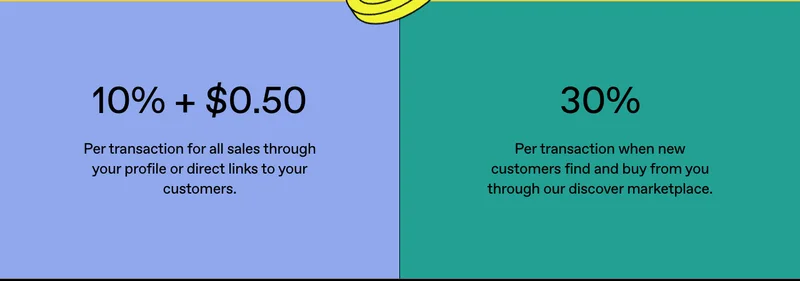
What it does not do is send you customers. Direct sales through your own link cost 10% plus $0.50. Sales that arrive through Gumroad’s Discover marketplace cost a flat 30%. Both figures are on Gumroad’s pricing page. Card processing is charged on top of the direct rate, and the cost section below puts real dollar amounts on that.
That structure rewards sellers who already have an email list, a channel, or a following. It squeezes sellers with very cheap products and no traffic. Neither group is wrong to be here. They just need different plans.
So instead of another setup walkthrough, this guide gives you a decision. We cover what Gumroad handles, which product types fit, whether you can bring your own buyers, what the fees cost at your price, and how Gumroad stacks up against Etsy, Payhip, and other options. Then you get a five-question test. If the answer is yes, our step-by-step Gumroad guide picks up where this one ends.
What Does Gumroad Actually Do for a Digital Product Seller?
Gumroad is a creator commerce platform that hosts your files, takes payment, delivers downloads, and handles sales tax as merchant of record, with no monthly fee. Per Gumroad’s pricing page, it charges 10% + $0.50 on direct sales, so it earns only when you do. It does not supply traffic.
The pricing page says you can sell digital products, e-books, courses, tutorials, and memberships. The features page adds the specifics that shape product fit:
- Pay-what-you-want pricing for products where you would rather set a floor than a fixed price.
- Memberships and subscriptions billed monthly, quarterly, biannually, or yearly.
- License keys for software.
- Multiple versions of one product, such as PDF, ePub, and Mobi files for the same ebook.
- A page editor for a storefront, plus a custom domain or an embed on a site you already own.
Services work too. Once your account is 30 days old, you can sell calls, commissions, and tip-jar products, per Gumroad’s help center.
Now the part most reviews skip. Here is who does what:
| Job | Who handles it | Notes |
|---|---|---|
| Hosting and delivering your file | Gumroad | Buyers get their download after paying |
| Taking payment | Gumroad | Card processing is charged on top of the direct-sale fee |
| Sales tax collection and remittance | Gumroad | As merchant of record since January 1, 2025 |
| Paying you out | Gumroad | Weekly payouts, with each sale’s net amount held for at least 7 days |
| Finding buyers | You | Discover only opens up after you meet its rules |
| Email list and audience | You | Gumroad offers email updates and workflows for customers you already have |
| Positioning and pricing | You | Nobody will fix a weak offer for you |
Sources: Gumroad’s pricing page, Gumroad’s fee help article, and Gumroad’s payouts dashboard help.
Three rows are handled for you. The row that decides your revenue, finding buyers, is not.
Which Digital Products Fit Gumroad Best?
Products that buyers pick up because of who made them, such as templates, ebooks, software, presets, and memberships, fit Gumroad best. Products that shoppers find by searching a marketplace, such as low-priced printables, usually fit worse. Gumroad lists digital products, e-books, courses, tutorials, and memberships as sellable categories, per its pricing page.
Fit comes down to how buyers find the product. Someone who follows you will pay for a Notion template because they trust you. Someone typing “printable planner” into Etsy wants a page of options to compare. Gumroad is built for the first buyer.
Here is our read, based on Gumroad’s published features and how each product type usually gets discovered:
| Product type | Fit | Why | Check before you list |
|---|---|---|---|
| Templates and tools (Notion, spreadsheets, code snippets) | Strong | Buyers usually arrive from your content and want instant delivery | Write clear install or duplicate instructions |
| Ebooks and guides | Strong | PDF, ePub, and Mobi versions of one product are built in, and pay-what-you-want is available | Cheap ebooks lose the biggest share to the fixed $0.50 |
| Software, scripts, plugins | Strong | License keys are generated for you | Support requests are yours to answer |
| Presets, fonts, asset packs | Good | Discover has Design, Photography, and 3D categories | Crowded categories reward strong previews |
| Courses and video tutorials | Good | Courses, tutorials, and memberships are all listed as sellable | If you need cohorts, quizzes, or a community, confirm Gumroad supports them first |
| Memberships and subscriptions | Good | Billing runs from monthly to yearly | Recurring revenue needs recurring content |
| Music, samples, beats | Good | Lossless audio can be a paid version, and Discover has music categories | Check the licensing terms on any samples |
| Low-priced printables, planners, stickers | Weak | Shoppers search Etsy for these, and the fixed fee bites small prices | Etsy is the usual first home for these |
| Calls and commissions | Situational | Call and commission products are built in after 30 days | Payouts on commission-heavy accounts can be held for review |
Sources: Gumroad’s features page, Gumroad Discover, and Gumroad’s services help article. The fit ratings are our judgment.
Notice the pattern. The strong fits are products people buy because of who made them, or because they need a file right now. The weak fits are commodity products people buy because a search result put them on screen.
Want a playbook for a specific product? We cover Notion templates and ebooks on Gumroad, plus printables, where Etsy usually wins.
Can You Bring Your Own Buyers to Gumroad?
Gumroad’s Discover marketplace is locked behind three account rules: filled-in payout settings, a $100 balance from genuine sales, and a risk review that takes about 3 weeks on average after that, per Gumroad’s Discover help article. Your first buyers have to come from your own audience.
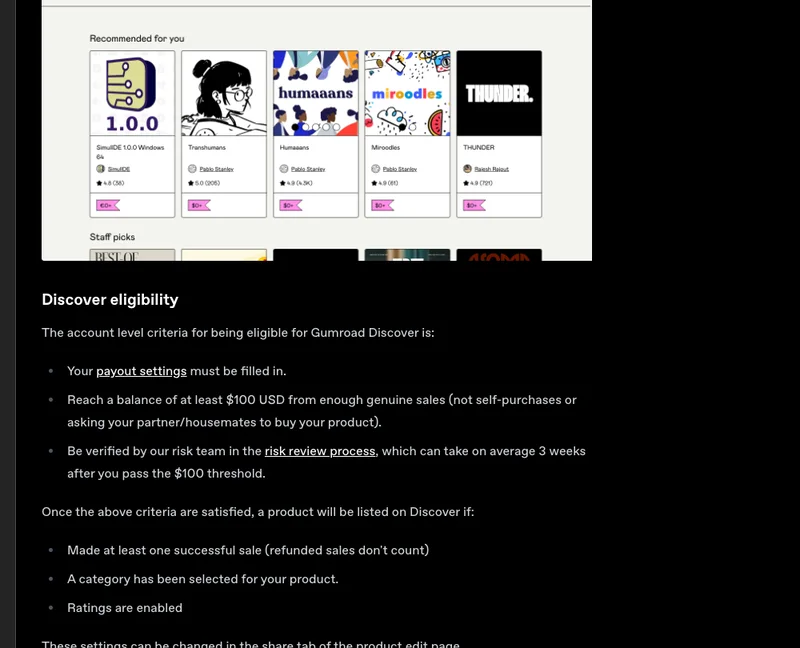
Read that list again. To be eligible for Discover, you need $100 in real sales first. Gumroad says self-purchases and asking housemates to buy do not count. Then comes a risk review. Then, for each product, you need at least one successful sale, a category, and ratings turned on.
Until all of that is done, every sale comes from a link you sent someone.
Once you are in, Discover is on by default. You can turn it off for a product by deleting its category. Products on Discover are also opted into Gumroad’s affiliate program automatically, per the same help article.
So the honest question is not “will Gumroad get me sales?” It is “where will my first buyers click from?” Run the traffic test:
- Do you have an email list, even a small one, that already reads what you write?
- Do you publish somewhere a buyer can click a link, such as YouTube, a newsletter, a blog, or a social account with real engagement?
- Can you name the post, video, or email that will carry your product link in launch week?
- Does anyone already ask you for this thing in comments, replies, or DMs?
Two or more yes answers means Gumroad’s model works for you. Four no answers means the platform is not your problem. Traffic is. Build it first, or start on a marketplace where demand already lives. Our Gumroad vs Etsy comparison covers that route.
Not sure what to sell on Gumroad in the first place? Take the free quiz. 2 minutes, zero fluff, matched to what you already have.
What Does Gumroad Really Cost at Your Price Point?
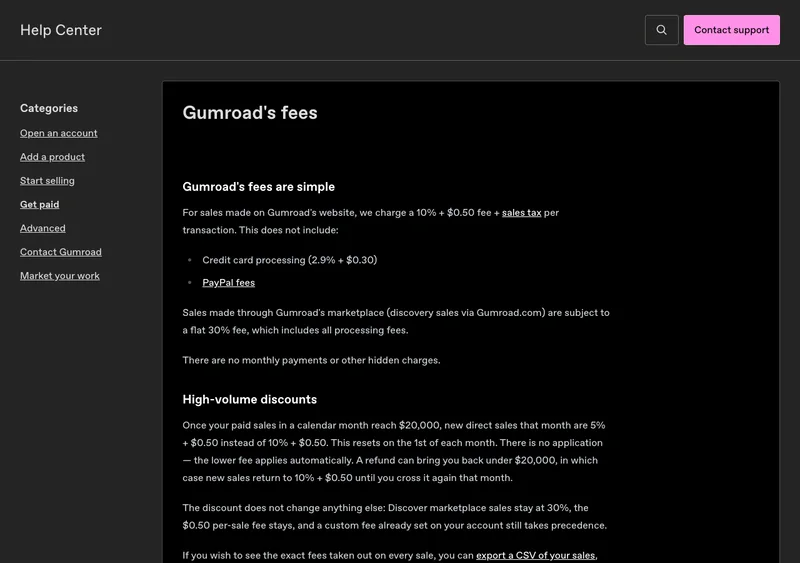
Gumroad charges 10% + $0.50 per direct sale and 30% on Discover sales, per its fee help article. Card processing (2.9% + $0.30) is not included in the direct rate. On a $19 direct sale, our math puts total fees near $3.25, about 17%. On a $5 sale, they reach about 29%.
You may see older write-ups call Gumroad’s fee a flat 10%. Gumroad’s own fee page today lists 10% plus $0.50, with card processing listed separately. That fixed $0.50 changes the math for cheap products.
Here is what a direct sale costs at common price points:
| Sale price | Gumroad fee (10% + $0.50) | Card processing (2.9% + $0.30) | Total fees | Share of the sale | You keep |
|---|---|---|---|---|---|
| $5 | $1.00 | $0.45 | $1.45 | 29% | $3.55 |
| $9 | $1.40 | $0.56 | $1.96 | 22% | $7.04 |
| $19 | $2.40 | $0.85 | $3.25 | 17% | $15.75 |
| $49 | $5.40 | $1.72 | $7.12 | 15% | $41.88 |
| $99 | $10.40 | $3.17 | $13.57 | 14% | $85.43 |
Our arithmetic from the rates in Gumroad’s fee help article. Assumes a card payment, no sales tax, and no affiliate. PayPal fees and other payment types will differ.
The fixed $0.50 is the part that hurts. It is a rounding error on a $99 product and a big slice of a $5 one. Below about $10, a bundle or a higher-priced pack usually fits Gumroad better than a single cheap file. Our guide to pricing digital downloads shows how to raise the price without losing buyers.
Discover sales work differently. On that same $19 product, a Discover sale costs 30%, or $5.70, and the help article says that figure includes processing. Compare that with about $3.25 for a direct sale. The extra $2.45 is the price of a buyer you did not have to find. That is fair if you would never have reached them. It is a bad trade if they were going to buy from your link anyway.
Three more details from the same help article:
- High-volume discount. Once paid sales in a calendar month reach $20,000, new direct sales that month drop to 5% + $0.50. It applies automatically and resets on the 1st. That is far from a first launch, but it means the fee percentage shrinks as you grow.
- Refunds. When you refund a sale, Gumroad returns its own fee on the refunded portion. It keeps only the processing portion, because payment processors do not give theirs back.
- Affiliates. Fees on affiliate purchases are split between you and the affiliate in proportion to their commission.
How Does Gumroad Compare With Etsy, Payhip, and Other Platforms?
Gumroad wins on setup speed and zero monthly cost. It loses on built-in search traffic. Etsy brings shoppers who search, but crowds every category with competitors. Payhip and other checkout tools compete on fees. Which platform wins depends on where your buyers already are, not on which fee looks smallest.
Most comparison posts rank platforms by fee. That misses the point. A lower fee on a store nobody visits earns you nothing. Start with where your buyers are, then check the fee at your price.
| Your situation | Start with | Why |
|---|---|---|
| You have an email list or a channel and one file to sell | Gumroad | Fastest path from file to paid, and you supply the traffic |
| You have no audience and sell low-priced printables or templates | Etsy | Buyers search there, so discovery is built in |
| You have an audience and the per-sale fee is your top worry | Compare Gumroad and Payhip at your price | Fees differ, and the fixed $0.50 matters most on cheap products |
| You want a full branded store with more than digital files | A store builder such as Shopify | More control over the storefront, at the cost of a monthly plan |
| You have outgrown Gumroad’s fees or features | An alternative | Run the numbers at your real volume first |
Our comparison guides go deeper on each route: Gumroad vs Etsy, Payhip vs Gumroad, Shopify for digital products, and the full list of Gumroad alternatives.
You do not have to pick one forever. Some sellers use a marketplace to reach strangers and a checkout they control for their own audience. Start with the single platform that matches where your first buyers are. Add a second when you have sales data that says it is worth the extra work.
Should You Sell on Gumroad? A Five-Question Test
Gumroad is the right call when you can answer yes to most of five questions: you can reach buyers, your product is a file, license, or membership, your price survives the fees, you will handle promotion yourself, and you value a fast, no-monthly-fee launch over built-in search traffic.

Answer these honestly. Write yes or no next to each.
- Can you name where your first buyers will come from? An email list, a channel, or a community counts. Hope does not.
- Is your product something Gumroad supports well? Files, software with license keys, memberships, and services all qualify. Check the fit table above.
- Does your price survive the fees? Look at the fee table. If you plan to charge under about $10, consider a bundle or a marketplace.
- Are you fine promoting and supporting it yourself? Gumroad handles checkout, delivery, and tax. It does not write your launch email or answer your buyers’ questions.
- Would a fast, low-risk test beat a perfect setup? With no monthly fee, you can list this week and find out whether anyone wants it before you commit to a bigger platform.
Score it:
- Four or five yes answers: List on Gumroad this week. Our step-by-step Gumroad guide and product listing guide take it from here.
- Two or three yes answers: List, but fix your weakest answer first. It is usually traffic or price.
- Zero or one yes answer: Do not start on Gumroad. Pick a marketplace where buyers already search, or build a small audience before you build the product.
Revisit the decision when the fees start to hurt at your real volume, when you need something Gumroad does not offer, or when a second channel makes sense. Until then, the best platform is the one you can actually launch on.
Frequently Asked Questions
Is Gumroad good for digital products?
Yes, if you bring your own audience. Gumroad hosts your files, takes payment, and handles sales tax as merchant of record, with no monthly fee, per its pricing page. It charges 10% + $0.50 on direct sales. It does not supply buyers on day one, so it fits sellers with an email list or channel.
What digital products can you sell on Gumroad?
Gumroad’s pricing page lists digital products, e-books, courses, tutorials, and memberships. Its features page adds software with license keys, pay-what-you-want pricing, and multiple file versions. After 30 days, accounts can also sell calls, commissions, and tips. Gumroad’s pricing FAQ bars illegal goods, gambling, and copyright infringement, among other categories.
How much does Gumroad take from each sale?
Direct sales cost 10% + $0.50, and Discover marketplace sales cost a flat 30% that includes processing, per Gumroad’s fee help article. Card processing (2.9% + $0.30) is charged on top of the direct rate. On a $19 direct sale, our math puts total fees near $3.25, or about 17%.
Does Gumroad bring you customers?
Only after you qualify. Discover requires filled-in payout settings, a $100 balance from genuine sales, and a risk review that averages about 3 weeks, per Gumroad’s Discover help article. Until then, every sale comes from links you share, so plan your own traffic before you list.
Does Gumroad handle sales tax for you?
Yes. Since January 1, 2025, Gumroad acts as merchant of record and manages sales tax collection and remittance worldwide, per its pricing page. You no longer configure tax settings for sales made through Gumroad. You still owe income tax on what you earn, so confirm reporting rules with an accountant.
Keep Reading
- How to Sell on Gumroad: The Complete Beginner Guide: full setup walkthrough from account creation to first sale
- How to Sell Digital Products on Gumroad: Step-by-Step: product types, listing optimization, and pricing
- Gumroad vs Etsy: Which Platform for Digital Products?: traffic, fees, and customer ownership side by side
- Best Gumroad Alternatives for Digital Product Sellers: for sellers who have outgrown the fees
What to Do Next
Choose the path that fits where you are right now.
Score Your Ideas
Answer a few questions about your skills, audience, and goals. Get a product type and selling platform matched to you.
Take the QuizGet Weekly Tactics
One tip, one tool, one case study. Every Tuesday.
Free. No spam. Unsubscribe anytime.